
Waterproofing systems are primarily used in the building industry. The COVID-19 pandemic has had a significant impact on this industry. Major issues include order shipment delays, supply chain constraints, manpower and equipment shortages, and material shortages. Following the end of the crisis, the construction market is expected to rebound, and demand for waterproofing systems is expected to rise. The pandemic has also increased the demand for construction activities in the healthcare sector. The growing demand for cost-effective and efficient waterproofing systems stems from the growing construction industry, with the hope that these systems can address the various challenges of establishing and implementing an effective and long-lasting waterproofing solution for specific construction projects, as discussed above.
On the other hand, more restraint factors and technological challenges are limiting the growth of the waterproofing system market. The use of waterproofing chemicals or membranes endangers both the environment and human health. Because of the release of toxic fumes, VOCs, and hazardous elements into the atmosphere, the presence of hazardous chemicals, solvents, plasticizers, diluents, and others in waterproofing systems causes some environmental and health safety issues. There is also a growing demand for developing more sustainable, recyclable, or even bio-based waterproofing materials to reduce their carbon footprints and reliance on raw materials derived primarily from traditional petroleum-based sources. New waterproofing systems are also required to meet the needs of sustainable construction projects such as green roofs and green buildings.
Fortunately, waterproofing manufacturers have recognized the challenges above and issues related to the environmental, health and safety, sustainability, and project need aspects of the waterproofing market. They have developed many new products and end-to-end solutions to address these issues. Figure 2 below depicts a new trend in the waterproofing solutions offered by manufacturers and distributors.
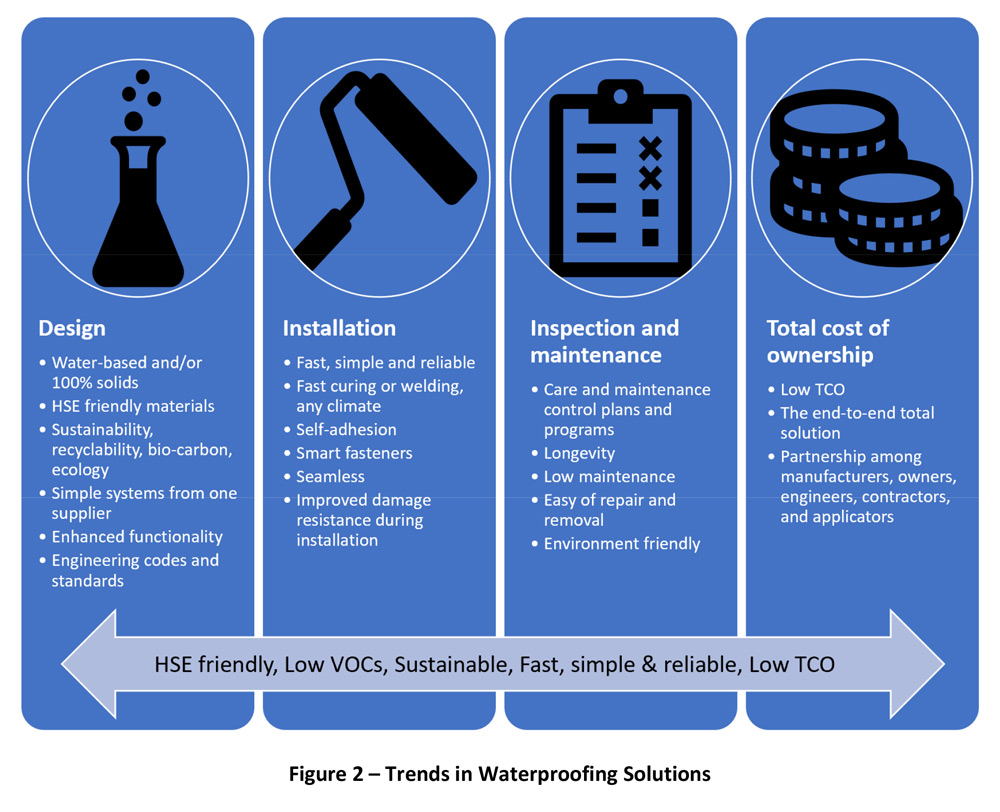
The two major trends in the waterproofing industry are the development of more sustainable products and the emphasis on improving product durability and functionality. Water-based liquid coatings (rather than traditional bitumen, coal-tar, or petroleum-tar-containing polyurethane coatings), silicones and silanes, polyurea, TPO (rather than traditional EPDM and even PVC membranes), and other more HSE-friendly products are being developed and used in the industry. Water-based coatings are odorless and do not necessitate any special ventilation. Splashes of droplets on the skin are not harmful and can be cleaned with soapy water. There is no need for specialized cleaning agents on the job site or for the equipment. Overspray and spills can be cleaned up with water if done immediately after application.
In terms of enhanced durability and functionality, a puncture/abrasion resistant spray on or peel-and-stick membrane and a seamless, and fastener or penetration free solution, are two topics that are frequently discussed. Peel-and-stick membranes are becoming a popular option for waterproofing in the ICF industry for its fast installation efficiency, but these sheet membranes are not without their challenges, and can be temperamental in less-than-ideal conditions. Poor installation, being left in the elements too long or careless backfilling often results in damages such as punctures, sagging, tears or folds that lead to trapped pockets of water unable to escape from behind the membrane. These concerns are not relegated solely to peel-and-stick membranes however and can be a viable problem for most product categories.
ICF is an abbreviation for insulated concrete form, which is a hollow stackable block made of rigid foam. Walls are built by stacking blocks, which are then filled with steel-reinforced concrete. ICF is becoming increasingly popular, particularly for green buildings and insulated basements. Waterproofing can be complex because the membrane must be applied to the foam. When discussing above-grade water protection in the waterproofing industry, many markets are also looking for added fire protection due to the increase in wildfires and such, and thus a waterproofing product with high fire resistance is also desired.
A waterproofing system that combines the class A fire rated coating with E-Glass is a recent development (can endure 600 degrees Celsius and is used to line ovens). Waterproofing manufacturers are also collaborating closely with distributors, general contractors, and applicators to provide end-to-end total waterproofing solutions, as well as to assist and train in project specifications and engineering details, design and material selection, on-site application training for fast, simple, and reliable installations, and customized care and maintenance programs.
Electronics industry advancements are also having a positive impact on the waterproofing industry. If a problem is detected, sump pumps can automatically contact building management. Rooftop leak detection systems can monitor for leaks continuously and call or sound an alarm if water penetration is detected.