The industry is full of classifications, so it’s advantageous to understand the difference between them all, especially when you’re dealing with project approvals or inspectors.
DEFINITIONS AS THEY PERTAIN TO COATINGS:
(LEVEL 1) Testing: Refers to the criteria’s outlined by bodies such as ASTM or CAN/CGSB for determining and evaluating specific performance criteria or physical properties of the materials. The tests are performed, and observations recorded by approved / recognized labs such as Intertek as an example. But who sets the coatings requirements for these tests? The standards.
(LEVEL 2) Standards: Refers to the regulators who have deemed oversight on products and companies attempting to classify that their products meet an expected criteria of performance indicators to be properly categorized. For waterproofing, nationally recognized boards such as the SWI, or Miami Date, have established a lesser exhaustive standard for waterproofing. Furthermore, government entities such as CCMC (Canadian Construction Materials), BNBC (National Building Code of the US) IBC (International Building Code) have developed their own standards criteria for the performance of waterproofing products. If the product performs and meets the standards, who or what oversees manufacturing, installation, environmental, and performance standards? The specification.
(LEVEL 3) Specifications: Refers to governing document that outlines everything, from what tests and standards the product needs to comply to or exceed, and then how that product needs to produced, packaged, labelled, applied, maintained and cared for.

Hulk Systems exceeds the specification standards set out in Specification 6839:2022 Water Resistant Membrane for Waterproofing Concrete and Insulated Concrete Form (ICF) Foundation Walls. This document requires products not only to conform or exceed a single standard, but multiple standards as listed below. So if anyone ever asks you, do you meet IBC, or UBC, or CCMC standards, you can confidently answer, “yes, and much more,” and then provide them the specification and your product certification letter.”
Here’s an excerpt from the specifications guide, which outlines all the standards and testing which the Hulk System exceeds. For the full specification view here. Details from the full specification guide WILL NOT appear on your module quiz. If you would like a copy of the full specification, please request one from us once successfully passing this course.
Global Coatings Advisors
Specification 6839:2022
Water Resistant Membrane for Waterproofing Concrete and Insulated Concrete Form (ICF) Foundation Walls
Specification Developer: Global Coatings Advisors
Published by Global Coatings Advisors
www.globalcoatingsadvisors.com
For ordering copies or for making inquiries with regard to this Specification, please reference the designation “GCA 6839 – 2022.”
Copyright @2022, 2023 GCA Global Coatings Advisors
Unless otherwise specified, no part of this publication may be reproduced or utilized in any form or by any means, electronic or mechanical, including photocopying and microfilm, without permission in writing from Global Coatings Advisors.
PART 1 GENERAL
1.1 Scope
The purpose of this specification is to establish the minimum level of requirements for recognition of both sheet and liquid water-resistant membranes in Global Coatings Advisors certification and evaluation reports under Division B of the National Building Code of Canada 2015 (NBC 2015), the 2003 International Building Code (IBC), the 2003 International Residential Code (IRC), the BOCA National Building Code /1999 (BNBC), the 1999 Standard Building Code (SBC) and the 1997 Uniform Building Code (UBC), in the areas defined by the objectives and functional statements attributed to the applicable acceptable solutions for foundation wall waterproofing. The product is meant to be installed on cast-in-place concrete, concrete block, unit masonry, sheathing, or insulated concrete form (ICF) substrates.
1.2 Definition
In this specification, the following definitions shall apply:
1.2.1 Water-resistant membrane: The term water-resistant membrane describes a material that is designed to serve as a secondary barrier behind an exterior cladding, providing a mechanism to resist penetration of liquid water that penetrates the structural parts of a building or its finished spaces. Its principal purpose is to resist hydrostatic pressure exerted by moisture in the liquid form. Waterproofing membranes consist of waterproof plastic, polymeric or rubber-coated-fabric materials. When appropriately installed, the materials prevent water penetration into foundations, roofs, walls, basements, buildings, and structures.
1.2.2 Insulated concrete form (ICF): Insulated Concrete Forms or ICFs are forms used to hold fresh concrete that remain in place permanently to provide insulation for the structure they enclose, resulting in cast-in-place concrete walls that are sandwiched between two layers of insulation material. The forms are often manufactured from high density Styrofoam or other sorts of lightweight materials. The insulated concrete forms are either pre-formed interlocking blocks or separate panels joined with plastic or metal links. ICF evaluations will have a distinct GCA Evaluation Report as there will be important elements in the requirements and restrictions of the GCA Evaluation Report that are special to ICF applications.
1.2.3 Proponent – the manufacturer or sub-manufacturer of a product or its sole Canadian distributor
1.3 References
1.3.1 Division B of the National Building Code of Canada 2015 (NBC 2015),
1.3.2 2003 International Building Code (IBC)
1.3.3 2003 International Residential Code (IRC)
1.3.4 BOCA National Building Code /1999 (BNBC)
1.3.5 1999 Standard Building Code (SBC)
1.3.6 1997 Uniform Building Code (UBC)
1.3.7 Canadian Construction Materials Centre (CCMC) Technical Guide for Cold, Spray- or Roller-Applied, Water-based Acrylic Elastomeric Membrane for Waterproofing Concrete and ICF Foundation Walls, CCMC-TG-071416.03, issued January 20, 2022.
1.3.8 American Society for Testing and Materials (ASTM)
1. C 836: Standard Specification for High Solids, Cold Liquid-Applied Elastomeric Waterproofing Membrane for Use with Separate Wearing Course
2. D 412: Standard Test Methods for Rubber Properties in Tension
3. D 522: Standard Test Method for Mandrel Bend Test of Attached Organic Coatings
4. D 570: Standard Test Method for Water Absorption of Plastics
5. D 903: Standard Test Method for Peel or Stripping Strength of Adhesive Bonds
6. D 1876: Standard Test Method for Peel Release of Adhesives (T-Peel)
7. D 1970: Standard Specification for Self-Adhering Polymer Modified Bituminous Sheet Materials Used as Steep Roofing Underlayment for Ice Dam Protection
8. D 2370: Standard Test Method for Tensile Properties of Organic Coatings
9. D 3767: Standard Practice for Rubber – Measurements of Dimensions
10. D 5385: Standard Test Method for Hydrostatic Pressure Resistance of Waterproofing Membranes
11. E 96: Standard Test Methods for Water Vapor Transmission of Materials
12. E 154: Standard Test Methods for Water Vapor Retarders Used in Contact with Earth under Concrete Slabs, on Walls, or as Ground Cover
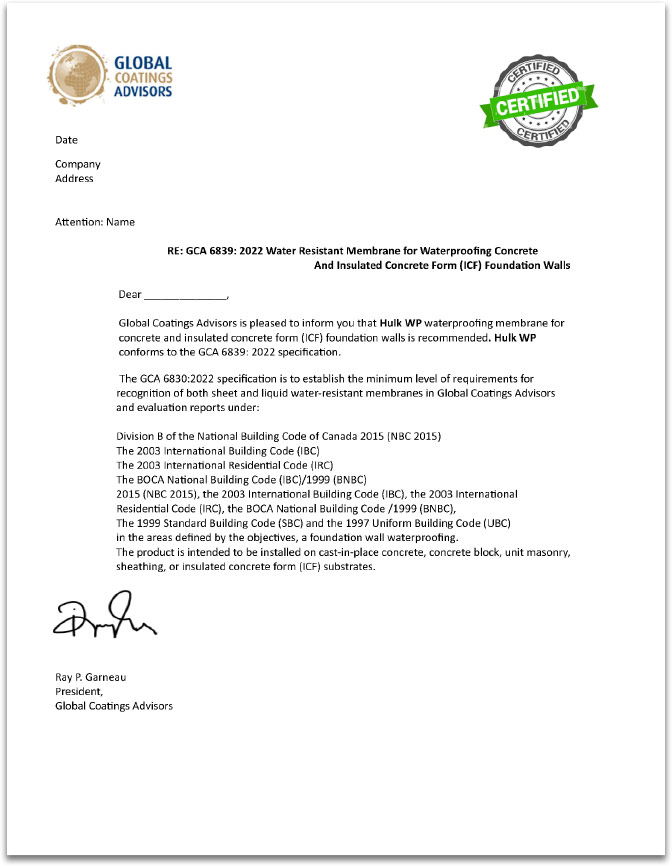
Certification Letter of Approval
This letter is available upon request as well and is issued by the oversight body of the specification, Global Coatings Advisors. Again, this letter does not certify you or your company as an installer. It proves that the product, Hulk WP membrane, conforms to all the requirements outlined in the specification document.