
First, let’s get educated on Airless Sprayers. Not all water proofers are painters. The differences between a plural tar or rubber truck mounted pump and an airless are vast, and the water proofer used to peel n’ stick may see this as a big step up from a pair of trusted shears or a utility knife. Our friends at Graco have put together some amazing instructions for your benefit. Remember, any of these instructions can be reviewed or printed off their website at the first link we gave you above.
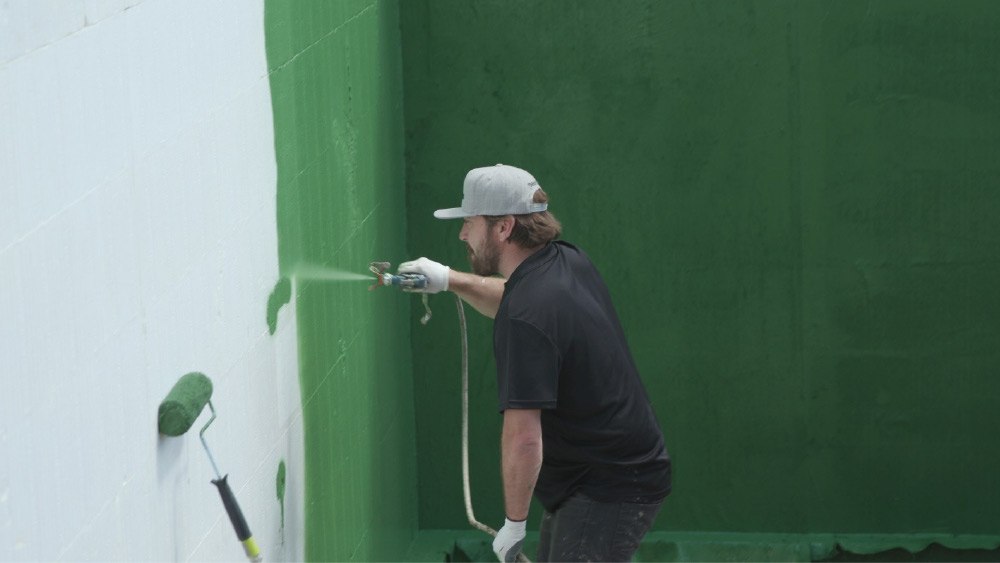
Airless Sprayers
These sprayers need neither a compressor nor a turbine.
Airless spraying is the fastest and most versatile way to achieve professional painting results and spray the widest variety of materials, un-thinned. In fact, using an airless sprayer is up to 10 times faster than using a brush, and at least four times as fast as a roller!
Airless spraying achieves this speed by atomizing, or breaking up fluid into small droplets, without the use of compressed air. Instead, fluid is pumped under high pressure through a spray tip. The fluid emerges from the tip as a high-speed solid stream – but when that stream hits the air, it becomes disrupted – and the fluid separates into very small droplets that form the spray pattern.
If you’ve ever placed your finger over the end of a running garden hose, you created a very simple form of airless spray.
The Components
When it comes to painting quickly and efficiently, professional painters rely on an airless sprayer. Spraying is four times faster than rolling, ten times faster than brushing and gives a smooth, professional finish.
So how does it work?
While Graco and Titan sprayers contain the most advanced performance and ease-of-use features, an airless sprayer can be understood with seven basic systems.
- Motor & Drive System – These work together to provide power to the pump and are available in both electric and gas-powered units.
- Piston Pump – This is sometimes called the heart of an airless sprayer because it’s really the most important part. The piston pump does the work of drawing the coating from your source bucket and then pressurizes the coating.
- Pressure Control Dial – This feature regulates the fluid pressure. When spraying, it is recommended to use the lowest fluid pressure at which atomization occurs. Spraying at lower pressure creates less overspray and makes equipment and tips last longer – saving you money on materials and equipment!
- Manifold Filter – This is designed to catch debris that may have entered your sprayer, catching and removing items that could otherwise impact your finish quality, damage your sprayer, or clog your spray tips.
- Fluid Hose – The fluid is delivered as a steady stream of high-pressure fluid through a hose to the spray gun.
- Spray Gun – The spray gun acts as the on/off valve for the material being sprayed. This is the last stop for the fluid before being applied and is a key item to provide a professional finish.
- Spray Tip – When the gun trigger is pulled, the fluid passes through the spray tip which uses different orifice sizes and shapes to control the spray pattern and the amount of fluid the gun releases.